





Moon jellyfish: the ones you can swim through
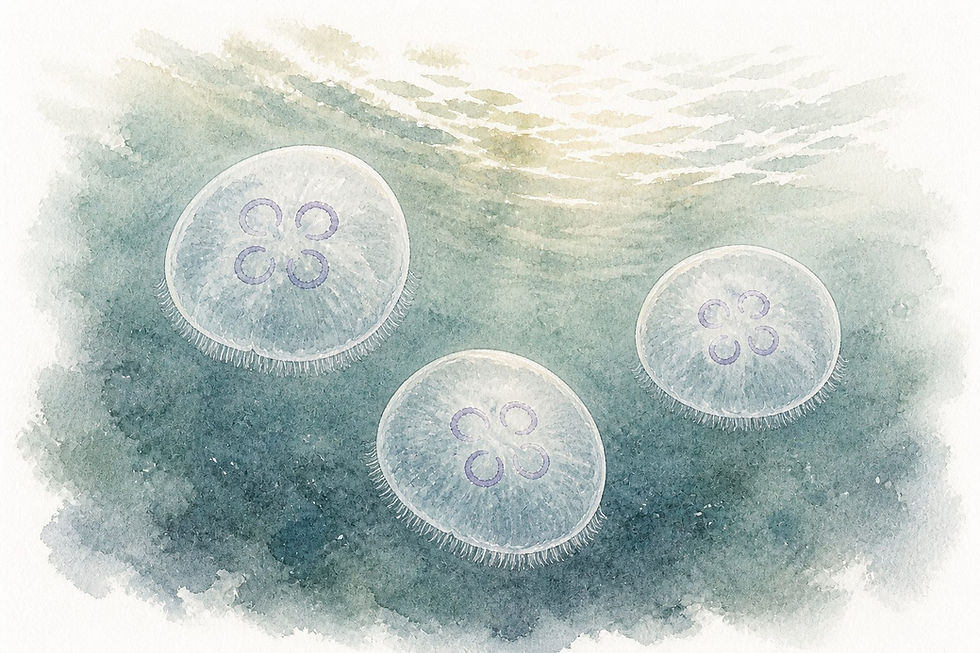
Somebody gets out of the water every summer convinced they have had a narrow escape. Almost always they have swum through a bloom of moon jellies, which is roughly as dangerous as swimming through a cloud.
Knowing one on sight
Aurelia aurita, the moon jelly. A clear, saucer-shaped bell, often the size of a side plate, with a fringe of very short fine tentacles round the rim rather than long trailing ones. The give-away is the four pale horseshoe rings visible through the top of the bell.
People assume those rings are the stomach or the eyes. They are the gonads — the reproductive organs — sitting just under the surface of the bell. Four horseshoes, clearly visible, and no other jellyfish on this coast looks like that.
The sting, or the lack of one
Moon jellies do have stinging cells, like every jellyfish. Theirs are simply not up to the job on human skin. Most people feel nothing at all. Some notice a very mild tingle on thin skin — the inside of the wrist, the face — and that is the top of it.
In a wetsuit, hood and gloves you will not register them whatsoever. Divers swim through them constantly here and think nothing of it.
The one that does sting
Lion's mane is the jellyfish worth learning, and the good news for Kilkee is that we rarely see them. It is a different animal entirely: a big reddish-brown bell and a dense mass of long hair-like tentacles trailing well behind it. Those tentacles sting properly, they stay active when detached, and a piece of one washed up on the sand will still get you.
The distinction is easy once you have seen both. Clear saucer with four rings and a short fringe, harmless. Brown and hairy with long trailing tentacles, leave it alone.
Clear and round with four rings, swim on. Brown and hairy with long trailing tentacles, give it room.
Why they arrive in numbers
Moon jellies are plankton feeders and barely swimmers. They pulse enough to stay upright and otherwise go where the water goes. That is why they turn up all at once — wind and current concentrate them, and a bay can fill overnight and empty just as fast.
A big bloom is a sign of a productive summer sea rather than anything wrong. It follows the plankton, and so does everything else worth seeing out there.
If you do get stung by something
Get out, rinse with sea water rather than fresh, and lift off any tentacle pieces with the edge of a card rather than your fingers. Do not rub it with sand. If someone has a severe reaction, breathing trouble or a very large sting area, treat it as a medical matter and ring 112 or 999. Call into us on the pier if you are unsure — we would rather look at it than have you guess.


Comments