


Cuckoo wrasse: the most colourful fish in Irish water, and every blue one started out female
- Frank Cosgrove
- 7 days ago
- 2 min read
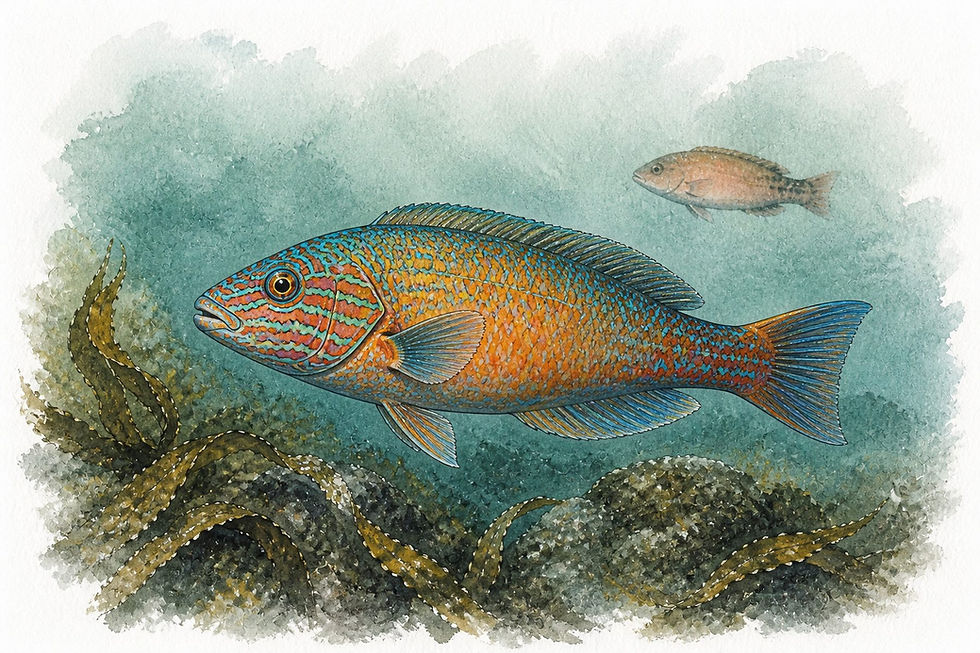
People who have only snorkelled in Ireland do not expect this fish. Electric blue over orange, moving along a reef in Clare water — it looks like something that has swum in from a warmer sea and taken a wrong turn. It has not. It lives here.
Two fish that are one fish
Labrus mixtus, the cuckoo wrasse. The male is blue and orange, with vivid blue markings running back over the head and along the body, and he gets brighter still in the breeding season. The female is a completely different animal to look at — orange-pink, with three dark blotches near the base of the tail and no blue at all.
They were once taken for separate species, which is entirely understandable. New divers regularly log them as two different fish on the same dive.
Every male was once a female
This is the part worth knowing. Cuckoo wrasse are protogynous hermaphrodites: they all start life as females, and some of them later change sex and become males. It happens at around seven to nine years old, and the change is not cosmetic — the ovaries reorganise into functioning testes and the fish switches into full male colouration.
So every blue male on that reef spent the first part of his life as an orange female. There is no such thing as a cuckoo wrasse that was born male.
The change is triggered socially. A dominant male holds a territory with females in it, and his presence suppresses the change in the others. Remove him — he is taken by something, or caught — and the largest female begins turning male within days. Behaviour goes first, then colour, then the reproductive anatomy. The reef repairs its own gap.
Take the male off a reef and the biggest female becomes him. It is one of the strangest true things in Irish water.
The nest
In late spring and early summer the male builds a nest in a crevice or under a ledge, gathering seaweed into it. He courts females into it, and then he guards the eggs — actively, against everything, including divers who get too close. A cuckoo wrasse repeatedly getting in your face in June is not being friendly.
Back off and give the ledge room. He has a job to do.
Where and when you see them
Rocky reef with structure — broken ground, ledges, kelp edges. They are generally a bit deeper than the ballan wrasse that dominate the shallows, and they are inquisitive: a cuckoo wrasse will often come to look at you rather than leave. They are also strictly daytime fish, wedging into a crack at night, which is why night dives on the same reef feel empty of them.
They live a long time for a fish of that size — well into their teens — which is worth remembering, because the big blue male you are looking at may be older than the diver beside you thinks.
Colour underwater falls off fast with depth, so bring a torch if you want to see them properly — at 15 metres in ambient light that blue is a dull grey, and a torch turns it back on. Conditions for Kilkee are live on our home page.


Comments